
July 17, 2025 | By Selin Capan

As artificial intelligence (AI) tools become part of everyday life, how can we ensure students are prepared not just to use AI, but to understand it and engage with it responsibly? What does it mean to be AI-literate? What should AI literacy look like throughout a student’s K–12 education?
The Promoting AI Literacy in K–12: Components, Challenges, and Opportunities report from the CIGALE project, an internal research and development project at SRI Education, explores these questions. Based on interviews with nine educators, researchers, and practitioners working at the intersection of education and AI, the report provides timely insights about AI literacy in K–12 as AI becomes increasingly integrated into classrooms and emerges as a growing national priority.
What is AI literacy?
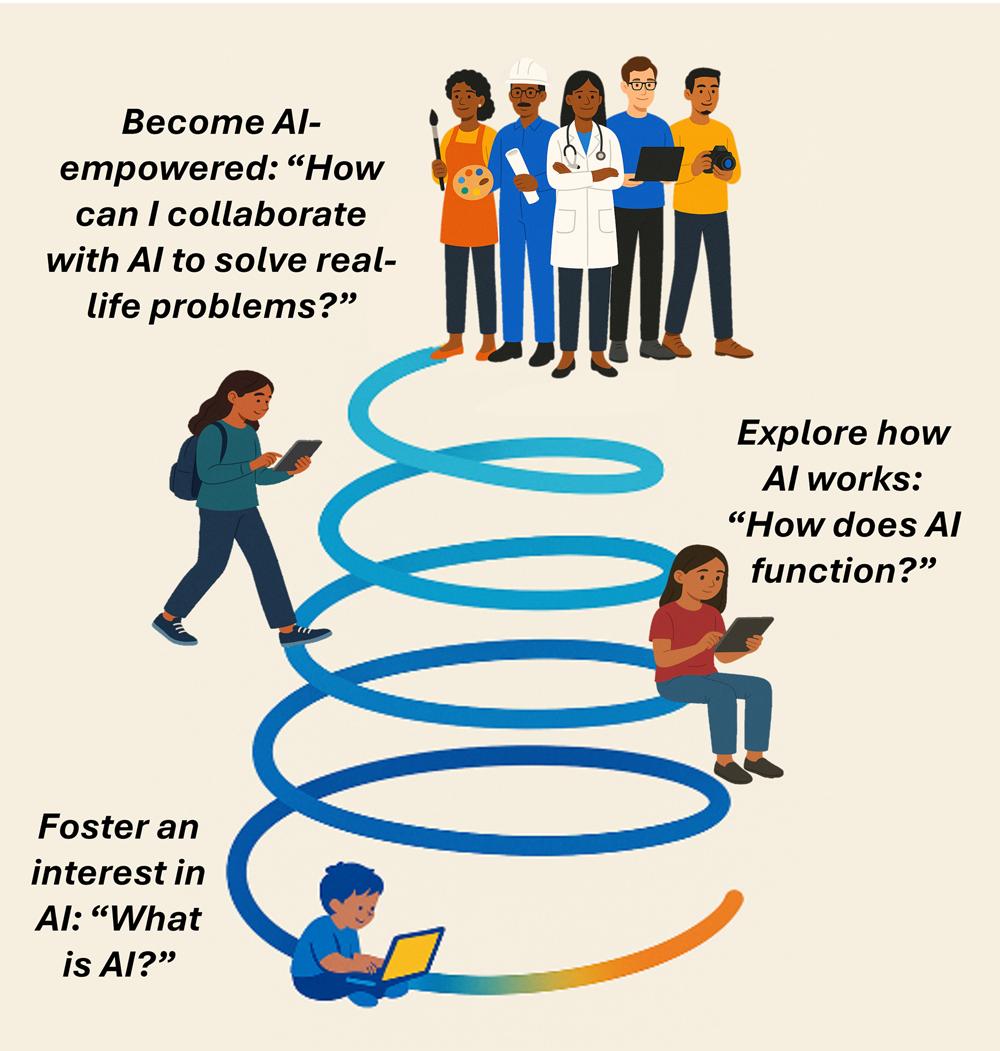
In a world where AI is constantly evolving, it’s important to define what AI literacy means. Our nine interviews revealed three interrelated pillars of an operational definition of “AI literacy for everyone”:
- Fundamental understanding of AI concepts
- Using and interacting with AI tools and AI agents
- An AI user identity, including a clear understanding of how to collaborate with AI in creative, ethical, and responsible ways
These key pillars can help guide a thoughtful approach to education about AI and using AI in classrooms. Experts outlined an “upward spiral,” a learning progression that starts with concrete, developmentally appropriate concepts in early grades and gradually builds to more advanced, interest-driven learning over time. And AI literacy doesn’t have to stay in the computer lab. Some experts emphasized it can and should be integrated into other disciplines such as English, social studies, and beyond.
What are some examples of promoting AI literacy in K–12?
Experts shared some inspiring work already happening that reflects the three components of AI literacy. One expert’s work includes middle school programs that demystify AI via interactive demos, providing students with background knowledge on what AI is and ways to leverage it effectively. Another educator utilizes AI tools in English classes as an augmenting and reinforcing tool. By grading students’ conversations with chatbots as well as including oral presentations as part of the assignment, the teacher is able to gauge students’ understanding of the subject while providing them with an opportunity to position themselves as responsible and creative users of AI.
What are current challenges from the field?
Despite these successful examples, experts also shared several challenges from the field:
- Students often use AI tools before knowing the capacity of AI and how to use it, which can lead to misconceptions or misuse.
- Most teachers don’t have a background in computer science and are becoming AI users alongside their students.
- AI tools can move instruction toward learning with real-time, personalized feedback, an exciting opportunity that also requires a mindset shift from traditional pedagogies.
How can we support teachers?
Across all interviews, one message stood out: Teachers need support, in both becoming AI literate and knowing how to integrate AI into their instruction. This starts with professional development that is practical, relevant, and easy to apply in the classroom. Teachers have busy schedules, so they also need time, resources, guidance, and support from their schools and districts to make meaningful AI literacy integration possible.
However, while the experts shared great examples of professional development happening already, there’s still a critical lack of high-quality, widely available programs provided by qualified professionals.
What’s ahead?
Reflecting on these insights, it’s clear that AI literacy in K–12 is essential and urgent. As AI technologies continue to evolve, we must ensure students and teachers are prepared and supported. This means investing in practical teacher professional development, intentional integration of AI literacy in K–12, and continuous collaboration among educators, researchers, and practitioners.
Read the full report to learn more about expert insights into the key components of AI literacy and how we can better support students and teachers.